What does a research-grade Certificate of Analysis contain?
A Certificate of Analysis (COA) is the primary analytical document accompanying a research-grade peptide. It records the results of testing performed on a specific manufactured batch — covering compound identity, purity quantification, and in some documentation packages, biological safety parameters. For a COA to serve its purpose as research documentation, it must contain a defined set of data fields rather than a general specification statement.
A batch-specific COA for a research-grade peptide should include: the compound name and CAS number, the batch or lot number linking the document to a specific production run, the analytical testing date, the name and location of the testing laboratory, the HPLC purity result with the testing method specified, and a mass spectrometry result confirming compound identity. Additional parameters — endotoxin levels, water content, and physical appearance — appear in more complete documentation packages and are relevant for applications requiring higher analytical certainty.
The critical structural distinction is between a batch-specific COA and a generic specification sheet. A specification sheet states the target parameters a compound is intended to meet. A COA records the actual measured results for a particular production lot. Research documentation requires the latter. A document that presents a purity figure without a batch number, testing date, and originating laboratory name cannot verify that the material in a specific container meets any particular standard for that production run.
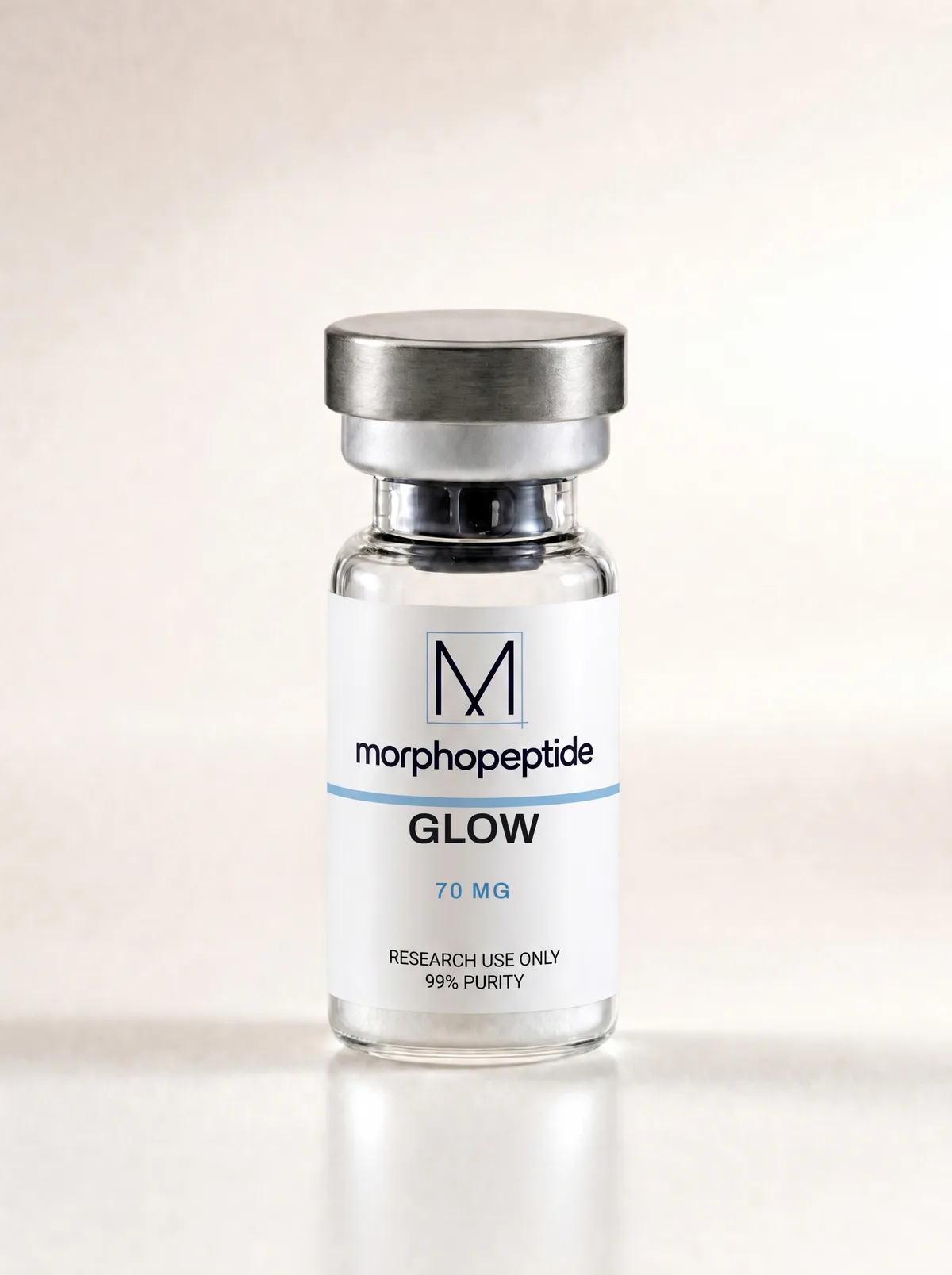
At Morphopeptide, every compound is documented with a batch-specific COA as standard. The COA includes batch identification, HPLC chromatogram data, and mass spectrometry confirmation. All compounds are intended solely for research purposes and are not for human use.
What does HPLC purity quantification measure?
High-Performance Liquid Chromatography (HPLC) is the standard analytical method for quantifying peptide purity. The technique separates molecular components in a prepared sample by passing it through a stationary phase column under high pressure. Different components interact with the column differently and elute at characteristic retention times. The detector — typically a UV absorbance detector — records signal intensity as each component exits the column, producing a chromatogram: a plot of signal versus time where each peak represents a discrete component.
Purity is calculated as a percentage of the total integrated peak area that corresponds to the target compound's retention time. A result of 99.4% purity means that 99.4% of the UV-absorbing material detected at the relevant wavelength elutes at the position corresponding to the target peptide. The remaining fraction represents detected impurities, which may include synthesis-related byproducts, incomplete deprotection products, oxidized variants, or peptide aggregates that co-elute as distinct peaks.
For research documentation, the purity percentage alone is not the complete record. The underlying chromatogram — showing peak resolution, main peak shape, baseline signal, and the relative area of any impurity peaks — provides the context required to assess data quality. A purity figure without the chromatographic trace cannot be independently evaluated for the validity of peak integration or column resolution. Researchers working with signaling assays or cell-based models where trace impurities can produce confounding data should verify that COA documentation includes the chromatogram rather than only the numerical result.
One constraint of HPLC: it quantifies purity but cannot confirm compound identity on its own. It establishes the relative purity of whatever is dominant in the sample, not what that compound is. Identity confirmation requires mass spectrometry.
Why is mass spectrometry required alongside HPLC purity data?
Mass spectrometry (MS) identifies a compound by measuring the mass-to-charge ratio (m/z) of its ionized form. For synthetic peptides, electrospray ionization (ESI) generates multiple charge states that produce a characteristic distribution of m/z signals. The deconvoluted molecular mass derived from this distribution is compared against the theoretical molecular weight calculated from the peptide's amino acid sequence. A match within acceptable instrument tolerance confirms that the compound is structurally consistent with its stated identity.
HPLC and MS answer different questions and are not substitutes for each other. HPLC answers: how pure is the material detected in this sample? MS answers: is the dominant material in this sample the compound it claims to be? A sample can yield a high HPLC purity reading — indicating a single dominant peak — while still being a different peptide with a similar chromatographic retention time, or a synthesis product with the correct sequence but a modification at one residue. Mass spectrometry catches identity errors that HPLC purity data cannot.
For peptides above approximately 500 Da, the MS report should document the observed m/z signals across detected charge states, along with the deconvoluted molecular mass and its agreement with the theoretical value. Morphopeptide includes mass spectrometry identity confirmation in the COA documentation for all compounds in its catalog, as a non-optional component of the analytical record, not an optional add-on.
What does endotoxin testing assess, and when is it relevant to peptide research?
Bacterial endotoxins — specifically lipopolysaccharides (LPS) originating from the outer membrane of gram-negative bacteria — are a contamination variable in synthetic peptide manufacturing. The concern is context-specific: endotoxin contamination at even low concentrations can activate innate immune signaling in mammalian cell models, producing signal pathway activity that can confound assays examining immune-related pathways, cytokine production cascades, NF-κB activation, or related signaling readouts.
Endotoxin levels are quantified using the Limulus Amebocyte Lysate (LAL) assay or its recombinant-based equivalent, recombinant Factor C (rFC). Results are reported in Endotoxin Units per milligram (EU/mg). The acceptable threshold is not universal — it depends on the specific research application. Cell-based assays examining cytokine pathways or receptor signaling require lower endotoxin levels than structural biochemistry work or studies not using live cells.
The practical relevance of endotoxin documentation is application-dependent. For in vitro signaling studies involving immune pathway readouts, cytokine measurements, or receptor activation assays in cell culture, endotoxin levels are a critical variable that must be characterized to ensure signal specificity. For structural or physicochemical work where cells are not involved, endotoxin levels may not affect experimental outcomes. Researchers should assess whether their experimental design is sensitive to endotoxin prior to selecting materials and request endotoxin data where it is analytically relevant.
What distinguishes a batch-specific COA from a generic specification sheet?
The distinction carries direct consequences for research traceability. A generic specification sheet is a product-level document: it states the intended or claimed parameters for a compound class but does not represent the results of testing on any particular production batch. It contains no batch number, no testing date, and no laboratory identification for the specific material a researcher is holding.
A batch-specific COA is a batch-level document: it records the actual measured results from testing performed on the specific lot from which a researcher's material was dispensed. The batch number links analytical data to the physical material; the testing date establishes when the measurement was made; the laboratory identification establishes accountability for the analysis.
From a research documentation standpoint, only the batch-specific COA provides traceability. Research relying on compound purity specifications should trace those specifications to a specific batch, not a product-level claim. When COA documentation cannot be matched to a batch number, the purity figure is not verifiable for the material actually in use.
Parameter
Generic specification sheet
Batch-specific COA
Batch/lot number
Absent
Required
Testing date
Absent
Required
Laboratory identification
Absent
Required
Chromatogram data
Rarely included
Standard (research-grade)
Traceability to material in hand
None
Full
The prevalence of generic specification sheets in the research peptide market — and their occasional presentation as equivalent to batch-specific COAs — is one reason researchers should know to ask for the batch number before accepting documentation at face value.
What purity thresholds define research-grade peptide material?
Purity thresholds for research peptides are not standardized across the industry by any single regulatory body, but conventional benchmarks have emerged from common analytical practice and institutional purchasing standards.
≥95% HPLC purity: Considered a minimum threshold for general research screening. Suitable for initial compound identification work and low-sensitivity assays where minor impurities are unlikely to produce confounding signals.
≥98% HPLC purity: The conventional minimum for more demanding research applications, including cell-based assays, receptor binding characterization, and concentration-response experiments where impurity-derived signal could compromise data interpretation.
≥99% HPLC purity: The standard for high-precision research contexts — signaling pathway studies, in vitro models with sensitivity to low-concentration impurities, and work where result reproducibility across independent experiments is required.
Morphopeptide holds all compounds in its catalog to a minimum purity specification of 99%+ by HPLC. Exact purity values for individual compounds are documented in the compound datasheet and COA. Compound-specific purity specifications, molecular data, and available sizes are listed on each product page in the compound catalog.
How does Morphopeptide structure its analytical documentation?
Morphopeptide maintains a datasheet-first documentation model. Each compound in the catalog carries its molecular data — CAS number, molecular formula, molecular weight, purity specification, and storage conditions — as the primary reference layer on the product page, not as supplementary background. This structure reflects the principle that analytical specifications are the foundation of a research compound's identity, not a marketing addendum.
For every batch, a batch-specific COA is provided as standard documentation. The COA documents HPLC purity quantification including chromatographic data and mass spectrometry identity confirmation. All compounds are stored at −20°C to protect purity specification prior to shipment.
The complete compound catalog, including molecular specifications and available research quantities, is accessible at all compounds. Researchers evaluating specific compound documentation can contact the team prior to ordering. All material is intended for laboratory research use only and is not for human use.
Research chemicals supplied for laboratory and scientific research purposes only. Not for human use. These products are not intended to diagnose, treat, cure, or prevent any disease. Morphopeptide does not sell products for human consumption. Researchers are responsible for compliance with all applicable local, state, and federal regulations governing the purchase and use of research materials.