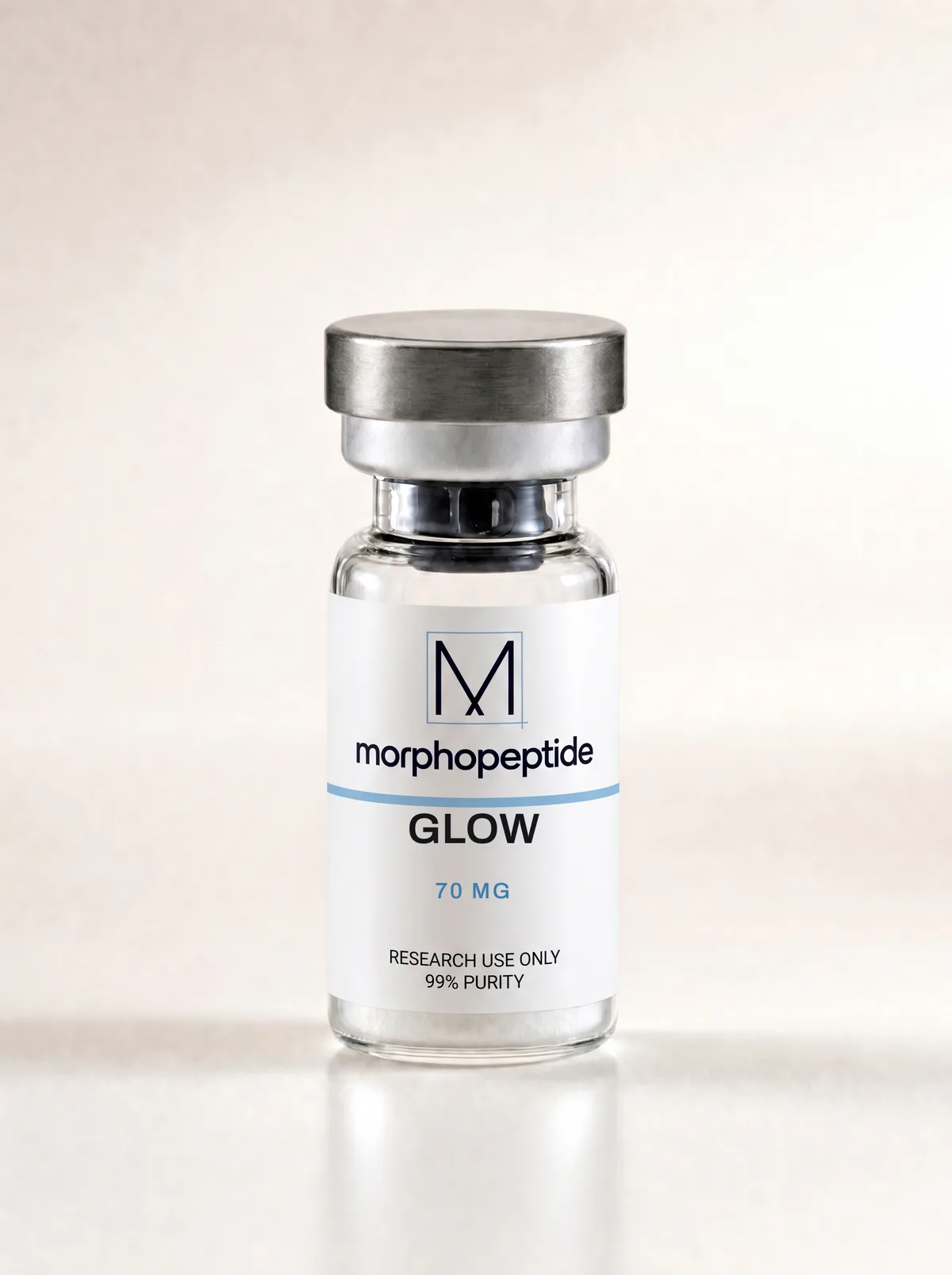
BPC-157 is a synthetic pentadecapeptide, meaning a chain of 15 amino acid residues, with molecular formula C62H98N16O22, a molecular weight of 1419.56 g/mol and CAS number 137525-51-0. In cellular signaling research it is treated as a defined chemical entity added to cell-based assays so that pathway events can be read out. It is supplied for laboratory research only and is not for human use.
Signaling research asks a narrow kind of question: when a defined cell population meets a defined compound under defined conditions, which intracellular events change, in what order, and how can they be measured? This article walks through the pathway categories reported in the published literature on BPC-157, the readouts used to examine them, and the material-identity checks that make results comparable between laboratories. All content is for research purposes only.
Which signaling pathways appear in published BPC-157 cell research?
Published cell-based work on BPC-157 has been organized around three pathway categories. The first is growth factor receptor signaling, with studies in fibroblast and endothelial models reporting examination of VEGFR2 and downstream focal adhesion kinase, pathways tied to cell migration and adhesion behavior. The second is NF-kB pathway activity, examined in cells challenged with inflammatory stimuli. The third is cytoskeletal and cell-survival signaling in epithelial models.
These categories are research frames, not conclusions about what the compound does. A pathway appearing in a study means it was measured, and the strength of any reported effect depends on the model, the readout and the controls. Published reports also differ in cell source and assay design, which is why comparing them requires attention to methods and not just headline findings.
For the fibroblast and endothelial work, the recurring theme is phosphorylation status of receptor-proximal proteins, since phosphorylation is a fast, measurable marker of pathway engagement. For NF-kB, the recurring theme is transcriptional output, since the pathway ends in gene expression that reporters can capture. For epithelial work, the recurring theme is structure: actin organization and monolayer integrity.
How is NF-kB pathway activity read out in cell models?
NF-kB activity is usually read out in two layers. The first layer is transcriptional: a luciferase or fluorescent reporter placed under an NF-kB response element converts pathway activity into a continuous, quantitative signal. The second layer is secreted protein: ELISA or multiplex immunoassay formats measure cytokines released into the medium after an inflammatory challenge such as lipopolysaccharide.
The two layers answer different questions. A reporter shows whether transcription downstream of the pathway changed, while a cytokine panel shows whether the protein output changed. Agreement between them strengthens an interpretation, and disagreement is informative, since it can point to post-transcriptional regulation or to assay timing differences.
This is the part of BPC-157 research that connects most directly to the anti-inflammatory pathway lane. It is also the part most sensitive to experimental detail: the choice of stimulus, the timing of sampling and the baseline activity of the chosen cell line all shape what a reporter can show. A study that fixes those variables and reports them clearly is far easier to compare than one that does not.
What readouts are used for growth factor receptor signaling?
Receptor-proximal signaling is typically read out by Western blot for phosphorylated forms of the receptor and its downstream partners, normalized to total protein levels. Phosphorylation changes can occur within minutes, so these experiments rely on short, tightly timed sampling windows, often much shorter than the incubation times used for proliferation assays.
Functional assays are paired with the molecular readout to connect signaling to behavior. Scratch-wound closure quantifies how quickly a monolayer fills a mechanically created gap, and tube-formation assays quantify capillary-like network formation by endothelial cells plated on a basement-membrane matrix. Pairing a phosphorylation blot with a functional assay is the usual way to argue that a measured molecular event is connected to an observed cell behavior, although correlation in one model is not proof of causation.
For a broader view of the culture formats themselves, the Morphopeptide overview of BPC-157 in in vitro models covers fibroblast, endothelial, epithelial and explant systems in more detail.
How do cytoskeletal and survival readouts fit in?
Epithelial models add a structural dimension to signaling research. Actin cytoskeleton organization is imaged with fluorescent phalloidin staining, and monolayer integrity is quantified by transepithelial electrical resistance in cell lines grown on permeable supports. Cell-survival markers are measured with viability formats such as MTT or LDH release under stress conditions like growth factor withdrawal or oxidative challenge.
These readouts matter for signaling research because cytoskeletal change is both a consequence and a driver of intracellular signaling. A shift in actin organization can reflect upstream kinase activity, and can in turn alter receptor clustering and adhesion. Treating the cytoskeleton as a readout and not just a background structure gives signaling studies a way to link molecular events to measurable changes in cell form.
Why does material identity matter for signaling experiments?
A signaling readout is only as interpretable as the material behind it. Synthesis-related impurities can independently affect cell behavior, and a peptide that degrades in culture medium can produce a loss of signal that reflects breakdown rather than biology. For that reason, identity and purity checks belong in the design of any signaling experiment, not after it.
The core identity fields for BPC-157 are the 15-residue length, formula C62H98N16O22, molecular weight 1419.56 g/mol and CAS 137525-51-0. These should be compared against the certificate for the specific lot, noting the analytical method behind the purity figure, since chromatographic purity and mass confirmation answer different questions. The Morphopeptide article on research peptide analytical documentation standards describes what a certificate of analysis normally contains and how to read it.
A useful habit is to record the lot identifier and the date of the identity check alongside every signaling dataset, so that a later change in readout can be traced to a change in material and not guessed at.
How does BPC-157 signaling research compare with other anti-inflammatory pathway compounds?
Within the anti-inflammatory pathway lane, other compounds are studied through different frames. KPV, a tripeptide with molecular weight 342.43 g/mol and CAS 67727-97-3, is examined in melanocortin-receptor-related cell models, while GHK-Cu, at 340.38 g/mol for the free tripeptide, is examined in copper-coordination and extracellular-matrix contexts. BPC-157, at 1419.56 g/mol, is considerably larger than both.
The size difference matters for experimental design. A larger linear peptide has more sites for proteolytic cleavage in culture medium, so integrity checks across the incubation period carry more weight. Comparing across compounds therefore requires holding assay design constant and reporting identity data for each material, not assuming that a readout for one peptide transfers to another.
What are the limits of cellular signaling data?
Cellular signaling data is mechanistic evidence under defined conditions. A phosphorylation change in a single cell line reflects that line's receptor expression profile, and immortalized lines can diverge from primary cells. Cell culture also lacks systemic factors such as circulating enzymes, immune cell trafficking and organ-level feedback, so a pathway result does not by itself describe behavior in an intact organism.
Good practice is to state the model, the readout, the timing and the material identity in every report, and to treat each signaling result as one piece of a larger body of evidence. Researchers can review the molecular specification and available sizes on the BPC-157 product page. All material is intended for laboratory research use only.
This compound is a research chemical intended for laboratory and scientific research purposes only. Not for human use. It is not a drug, supplement, or food product, and is not intended to diagnose, treat, cure, or prevent any disease. Morphopeptide does not sell products for human consumption. Researchers are responsible for compliance with all applicable local, state, and federal regulations.
Reference
Common questions
BPC-157 is a synthetic pentadecapeptide, 15 amino acid residues long, with molecular weight 1419.56 g/mol. In cellular signaling research it is examined as a defined chemical entity in cell-based assays, with readouts such as protein phosphorylation and transcription reporters. It is supplied for laboratory research only and not for human use.
Published cell models have examined growth factor receptor signaling such as VEGFR2 and focal adhesion kinase, NF-kB pathway activity and cytoskeletal organization in epithelial cells. These are research frames reported in the literature, and findings in one cell type do not automatically transfer to others. All discussion here is for research purposes only.
Common readouts include Western blotting for phosphorylated proteins, luciferase or fluorescent reporter assays for transcriptional activity, and ELISA formats for secreted cytokines. Each answers a different question, so studies typically combine a pathway readout with a functional assay such as scratch-wound closure to connect molecular events to cell behavior.
A signaling result is only interpretable if the material behind it is known. Formula, molecular weight, CAS number, purity method and lot identity should be checked against the certificate, because impurities from synthesis can independently affect cell behavior and confound a pathway readout. This applies to any peptide used in cell-based research.