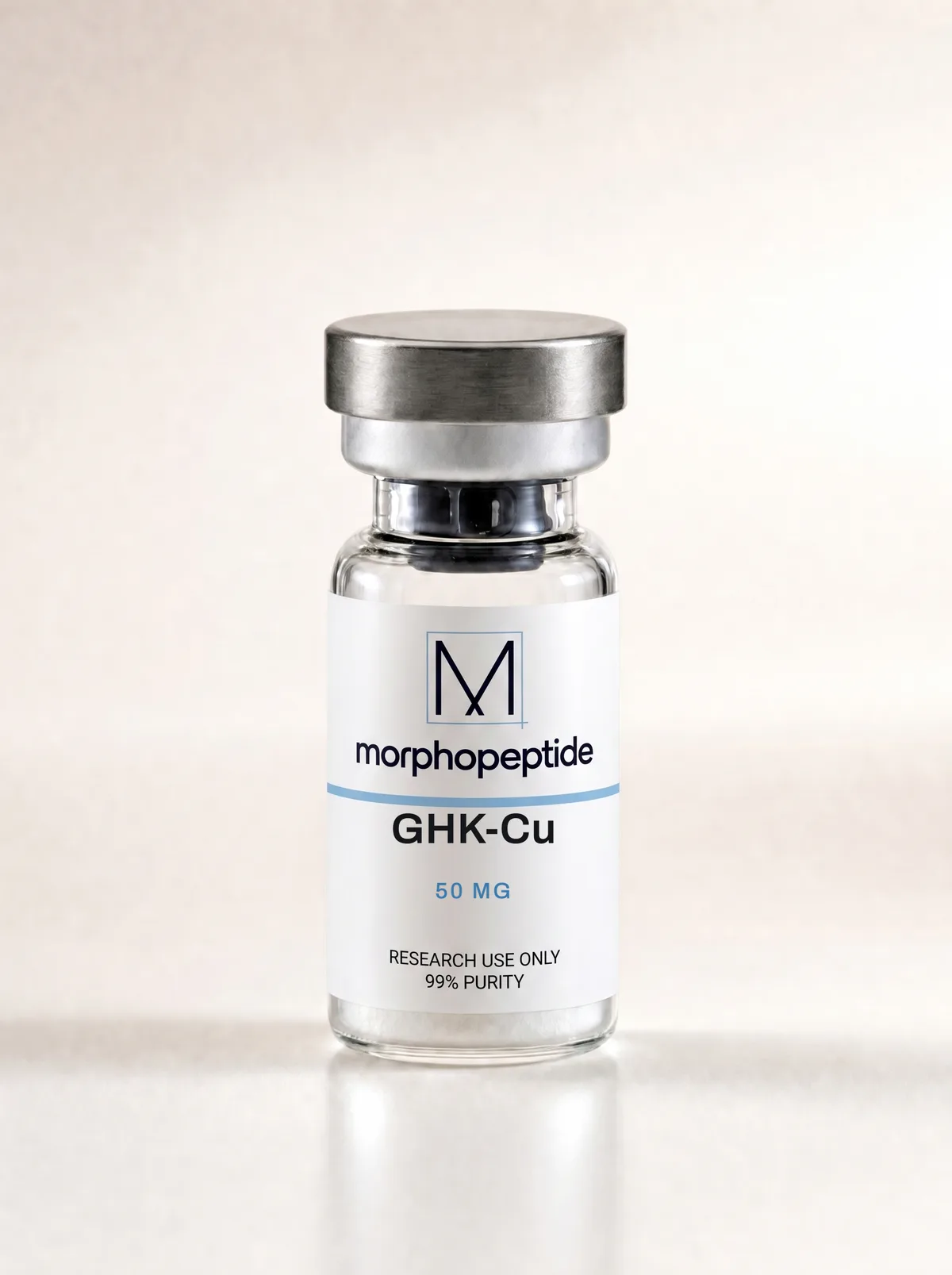
GHK-Cu is the copper(II) complex of the tripeptide Gly-His-Lys, studied in research for its copper-binding coordination chemistry and its interactions with matrix remodeling signaling pathways and anti-inflammatory cascades in cell-based and preclinical research models. The compound is also catalogued in the research literature under the INCI name Copper Tripeptide-1, reflecting the coordinated copper ion as a structurally essential element rather than an additive. It is supplied as a lyophilized powder intended solely for research purposes and is not for human use.
The free peptide GHK — Gly-His-Lys — is catalogued under CAS number 49557-75-7 and carries the molecular formula C₁₄H₂₄N₆O₄ with a molecular weight of 340.38 g/mol. When complexed with a single Cu(II) ion through coordination bonding — a process in which the copper ion displaces two protons to bind the tripeptide — the resulting GHK-Cu complex carries CAS number 89030-95-5 and an approximate molecular weight of 401.9 g/mol. The distinction between these two CAS registrations is analytically significant: they represent chemically distinct species, and research-grade material designated as GHK-Cu should be confirmed as the copper complex by both mass spectrometry and elemental analysis, not simply as the free tripeptide.
GHK occurs naturally in human plasma and has been detected in saliva and urine in trace concentrations. In research, GHK-Cu is examined specifically as the biologically active copper-complexed form, with the Cu(II) coordination chemistry considered inseparable from the compound's pharmacological properties in the signaling systems under study.
What is the molecular structure of GHK-Cu and how is copper coordinated?
GHK-Cu is a tripeptide composed of three amino acid residues — glycine (Gly), histidine (His), and lysine (Lys) — connected sequentially by peptide bonds, with the sequence running N-terminus to C-terminus as Gly-His-Lys. The free tripeptide GHK has a molecular formula of C₁₄H₂₄N₆O₄ and a molecular weight of 340.38 g/mol. Complexation with Cu(II) displaces two ionizable protons and adds a single copper atom, yielding the complex formula C₁₄H₂₂CuN₆O₄ at approximately 401.9 g/mol.
The copper coordination site in GHK-Cu is extensively characterized in published structural analyses. The Cu(II) ion is coordinated in a square-planar geometry through four nitrogen donor atoms: the terminal alpha-amino group of glycine, the deprotonated amide nitrogen of the Gly-His peptide bond, the imidazole nitrogen of the histidine side chain, and the deprotonated amide nitrogen of the His-Lys peptide bond. This ATCUN (amino terminal copper and nickel binding) motif — defined by the presence of a free alpha-amino terminus followed by a histidine at the third position — provides one of the highest-affinity copper-binding sequences among short peptides. Published thermodynamic data characterize the GHK-Cu complex as exceptionally stable relative to other copper-amino acid or copper-dipeptide complexes, a property that influences how the compound functions as a research model for copper-transport and copper-mediated signaling studies.
The lysine residue at the C-terminus does not participate directly in the copper coordination sphere but contributes to the overall charge distribution and solubility profile of the complex. The free epsilon-amino group of lysine remains available for interaction in solution, and published studies have examined its role in the compound's binding interactions with extracellular matrix components and cell surface heparan sulfate proteoglycans.
What is the ATCUN motif and why does it matter for GHK-Cu research?
The ATCUN (amino terminal copper and nickel binding) motif is the structural determinant that defines GHK's exceptional copper-binding capacity. A peptide carries an ATCUN sequence when its N-terminus is free, the second position is any amino acid, and the third position is histidine — a configuration that creates the four-nitrogen square-planar coordination site described above for GHK-Cu. This arrangement is found in a small number of biologically significant copper-binding peptides and proteins, including the N-terminal sequence of human serum albumin, which carries a similar Asp-Ala-His ATCUN motif.
In research contexts, the ATCUN motif in GHK-Cu is significant for two reasons. First, the thermodynamic stability of the coordination complex determines how the compound behaves in aqueous experimental systems — the copper ion is tightly held under physiological ionic conditions, distinguishing GHK-Cu from weaker copper chelates that release copper freely in solution. Second, the geometry of copper coordination in ATCUN motifs is studied in the context of copper-mediated redox chemistry: Cu(II) in stable square-planar coordination can participate in single-electron redox reactions with appropriate substrates, a property that is mechanistically relevant to GHK-Cu's studied interactions with reactive oxygen species signaling pathways in cell models.
The ATCUN framing situates GHK-Cu within the broader research field of copper-binding peptides as a structurally precise model system. Its short tripeptide length and thoroughly characterized coordination geometry make it amenable to both crystallographic structural study and solution-phase biophysical characterization, and published structural data on GHK-Cu provide one of the more complete pictures of ATCUN coordination available in the literature for a short synthetic peptide.
What matrix remodeling signaling pathways does research associate with GHK-Cu?
A central body of GHK-Cu research examines the compound's interactions with matrix metalloproteinase (MMP) signaling and extracellular matrix (ECM) remodeling pathways in cell-based models. Matrix metalloproteinases are zinc-dependent endopeptidases that cleave components of the extracellular matrix — collagens, fibronectin, laminin, and related structural proteins — and are regulated at the transcriptional, post-translational, and inhibitor-binding levels. The research interest in GHK-Cu in this context centers on observed effects on MMP expression and activity profiles in fibroblast cell models and wound-model cell systems.
Published research in fibroblast cell cultures has characterized GHK-Cu's effects on the transcriptional regulation of specific MMPs — particularly MMP-2 (gelatinase A) and MMP-9 (gelatinase B) — and on the expression of tissue inhibitors of metalloproteinases (TIMPs), the endogenous regulatory proteins that modulate MMP activity. The mechanistic picture emerging from this research describes GHK-Cu as shifting the MMP/TIMP balance in fibroblast models, with observed downstream effects on matrix component synthesis including collagen type I and III, fibronectin, and proteoglycan production measured at the mRNA and protein levels.
These matrix remodeling signaling observations are the mechanistic basis for GHK-Cu's sustained presence in ECM biology research. The copper coordination chemistry is considered functionally relevant to these effects: chelation of copper into the ATCUN complex is associated in published studies with distinct signaling interactions compared to the free GHK peptide or to copper salts administered separately, suggesting that the intact coordination complex — not the peptide or copper ion in isolation — is the pharmacologically active research entity.
What anti-inflammatory signaling pathways has research examined in connection with GHK-Cu?
Separate from matrix remodeling, a significant portion of GHK-Cu research examines interactions with anti-inflammatory signaling cascades. Published cell-based studies have characterized GHK-Cu's effects on NF-κB pathway activity — the same nuclear factor kappa-light-chain-enhancer of activated B cells transcription factor system studied in the context of compounds such as KPV — in fibroblast and macrophage cell model systems.
In macrophage and monocyte-derived cell models, GHK-Cu has been studied for its effects on cytokine secretion profiles following pro-inflammatory stimulation. Outcome variables measured in these experiments include TNF-alpha, IL-6, IL-1beta, and related pro-inflammatory cytokine protein levels, with GHK-Cu examined as a compound that modulates upstream signaling events regulating cytokine gene transcription. The NF-κB pathway is a convergent target in this research framing: published studies have measured IκB degradation kinetics, NF-κB nuclear translocation, and NF-κB-dependent reporter gene activity in cell systems treated with GHK-Cu under controlled concentration-response conditions.
A secondary anti-inflammatory signaling axis examined in published GHK-Cu research involves superoxide dismutase (SOD) activity modulation. Cu(II) is the cofactor for Cu/Zn-SOD, the enzyme responsible for dismutation of superoxide radicals to hydrogen peroxide and oxygen, and research has examined whether GHK-Cu can influence intracellular reactive oxygen species (ROS) levels through SOD-related mechanisms in cell models. This represents a distinct mechanistic pathway from direct receptor-mediated signaling: GHK-Cu in this context is studied as a copper-delivery or copper-activity-modulating compound affecting redox enzyme function rather than a conventional receptor agonist.
How does GHK-Cu compare structurally to other copper-binding research peptides?
In the broader landscape of copper-binding peptides studied in research, GHK-Cu occupies a specific position defined by the combination of its ATCUN coordination geometry, tripeptide length, and the defined biological origin of its sequence from human plasma. Structural comparison with other well-characterized copper-binding peptides in the research literature highlights what makes GHK-Cu a distinctive model system.
Human serum albumin (HSA) carries an ATCUN motif at its N-terminus (Asp-Ala-His) that is the primary copper-binding site responsible for albumin's role in plasma copper transport. GHK-Cu's coordination geometry at its ATCUN site is structurally analogous, and published studies have compared the two systems to understand the contribution of the surrounding protein environment versus the core coordination motif to copper-binding affinity and redox chemistry. GHK-Cu, as a synthetic tripeptide, allows isolation of the coordination chemistry from the complex structural context of a full protein — a research utility that the full HSA molecule cannot provide for mechanistic copper-chemistry studies.
Other copper-binding tripeptides and short peptides studied in research — including Gly-Gly-His, Gly-His (dipeptide), and various ATCUN-containing synthetic sequences — have been characterized in comparative thermodynamic and spectroscopic studies alongside GHK-Cu. These comparisons establish GHK-Cu's binding constant and coordination geometry as reference values in the copper-peptide literature, making the compound a benchmark for ATCUN-motif research rather than simply one entry among many.
How does Morphopeptide supply and document GHK-Cu?
Morphopeptide supplies GHK-Cu as a research-grade compound held to a purity specification of 99%+ by HPLC, with mass spectrometry identity confirmation against the theoretical molecular weight of approximately 401.9 g/mol for the copper complex. The compound is documented with a batch-specific Certificate of Analysis covering the chromatographic purity data and MS identity confirmation.
Storage conditions for the lyophilized material are −20°C, protected from moisture and light. As a small peptide-metal complex, GHK-Cu is sensitive to hydrolytic and oxidative degradation; the coordinated Cu(II) also introduces redox reactivity that can accelerate oxidative side-reactions in solution, making short working solution preparation times and inert atmosphere handling practices relevant in research settings. The compound should not be exposed to repeated freeze-thaw cycles, high humidity, or prolonged contact with oxidizing agents during research handling. This article does not provide preparation instructions; handling protocols are determined by the researcher according to experimental requirements and applicable institutional regulations.
Researchers can review the molecular specification, available sizes, and pricing on the GHK-Cu product page, or browse the full research compound catalog at all compounds. For guidance on interpreting the Certificate of Analysis documentation provided for each order, see the analytical documentation standards article. All material is intended for laboratory research use only.
This compound is a research chemical intended for laboratory and scientific research purposes only. Not for human use. It is not a drug, supplement, or food product, and is not intended to diagnose, treat, cure, or prevent any disease. Morphopeptide does not sell products for human consumption. Researchers are responsible for compliance with all applicable local, state, and federal regulations.